Korea builds gigawatts, Japan builds pods — and what 110 kW in Oklahoma has in common with Osaka
Asia’s two AI-infrastructure superpowers picked opposite strategies. Korea is pouring ~550 trillion won into 18.4 GW of national AI campuses; Japan is scattering liquid-cooled GPU pods through its cities. Both are right — for their constraints.
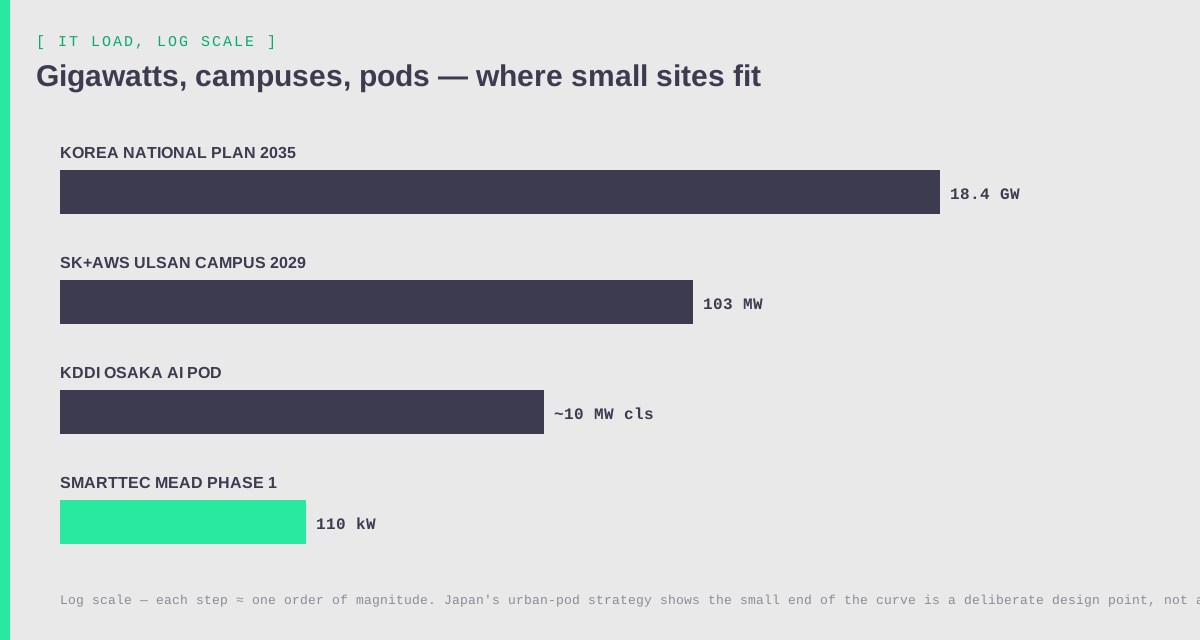
In June 2026, Korea’s government and its chaebols announced one of the largest infrastructure programs on earth: roughly 550 trillion won (~$400B) with SK, GS, and Naver to build 8.4 GW of AI data centers by 2029 and 18.4 GW by 2035 — SK alone targeting 5 GW including Ulsan, GS building 2.4 GW in Donghae, Naver anchoring Sejong. Separately, SK Group and AWS are building a 60,000-GPU campus in Ulsan that ramps from 41 MW in 2027 to 103 MW by 2029. Korean AI halls are being designed around 70 kW racks with PUE targets under 1.2.
Japan is running the opposite play. Instead of mega-campuses on cheap land, operators are deploying modular, containerized GPU pods inside and near cities — close to demand and to renewable feed-ins. KDDI’s Osaka Sakai center, built with HPE on NVIDIA Blackwell with direct liquid cooling, opened to customers in April 2026 as exactly this kind of distributed AI factory. And underneath it all, NTT’s IOWN program is rebuilding the network in photonics, targeting 125× capacity and 100× power efficiency by 2032 so that distributed sites behave like one.
Why the strategies differ
- →Korea has industrial land, gigawatt grid programs, and conglomerates that can underwrite decade-long buildouts — so it optimizes for scale economics and sovereign AI capacity.
- →Japan has scarce urban land, high power prices, and latency-sensitive customers — so it optimizes for proximity, modularity, and network efficiency (hence IOWN’s photonics bet).
- →Both accept the same physics: dense GPU racks, liquid cooling as default, and power as the binding constraint.
Where a 110 kW site in Mead, Oklahoma fits
Phase 1 at our Mead site — 30 NVIDIA B200s at roughly 110 kW of IT load — sits unambiguously at the Japanese end of the curve, and deliberately so. Our constraints look more like Osaka’s than Ulsan’s: a defined tenant base, owned buildings, and an advantage that comes from what the site already has (a 3 MVA transformer, ~$0.08/kWh power, z1power batteries behind the meter) rather than from what a nation can build. The pod strategy’s lesson is that matching capacity to committed demand beats building capacity and praying — our 30 GPUs are 100% pre-committed to six anchor tenants before power-on, which is the small-site superpower no gigawatt campus can copy.
Our 3 MVA transformer runs Phase 1 at under 4% utilization. Korea plans in gigawatts; we plan in buildings — the same site supports roughly 20× today’s load across Buildings 2–3 before any utility upgrade, funded by cash flow instead of a national budget.
Korea’s June 2026 national program targets 8.4 GW of AI data centers by 2029 and 18.4 GW by 2035, backed by roughly 550 trillion won of investment led by SK Group (5 GW including Ulsan), GS Group (2.4 GW in Donghae), and Naver (about 1 GW around Sejong). Separately, SK and AWS are building a 60,000-GPU, $4B campus in Ulsan scaling to 103 MW by 2029.
Rather than giant rural campuses, Japanese operators deploy small, modular, often containerized liquid-cooled GPU sites inside metropolitan areas, close to users and renewable interconnects. KDDI’s Osaka Sakai data center — HPE-built on NVIDIA Blackwell with direct liquid cooling, open since April 2026 — is a flagship example, and NTT’s IOWN photonics network aims to make distributed sites perform like one facility.
At the right design point, yes. Small sites win when capacity is matched to committed demand, land and power are already owned, and latency or data-residency favors proximity. They lose on $/GPU at massive scale. SmartTec’s 114 kW Phase 1A is contracted rather than oversubscribed, which converts small size into capacity certainty.
Korean AI campuses are being specified around 70 kW racks with PUE targets below 1.2, per market analyses of the 2026 buildout — figures that require liquid cooling and that mirror the direct-liquid-cooled Blackwell deployments in Japan.
- Korea targets 550 trillion won AI data center push — Seoul Economic Daily (Jun 2026)
- South Korea data center market analyses — Mordor Intelligence (Jan 2026)
- KDDI launches Osaka Sakai data center — Data Center Dynamics (Mar 2026)
- Japan’s urban data centre strategy — Business Weekly / Intralink (Mar 2026)
- NTT IOWN photonics platform — IEEE Spectrum (Dec 2025)