What China’s underwater data centers teach a landlocked Oklahoma operator
The world’s first commercial subsea data center has run 35 meters under the South China Sea for nearly three years. We operate on dry land in Mead, Oklahoma — and we’re taking notes anyway.
Off Lingshui county on Hainan island, capsule-shaped steel modules the weight of a thousand cars sit 35 meters below the surface, running cloud services and, increasingly, AI workloads. Operator HiCloud reports the cluster has run for close to three years, and in May 2026 a second subsea site went live off Shanghai — this one fed by an offshore wind farm of more than 50 turbines, housing roughly 2,000 servers at up to 24 MW. China’s stated plan for Hainan alone is a network of 100 underwater cabins.
Why put servers in the ocean at all
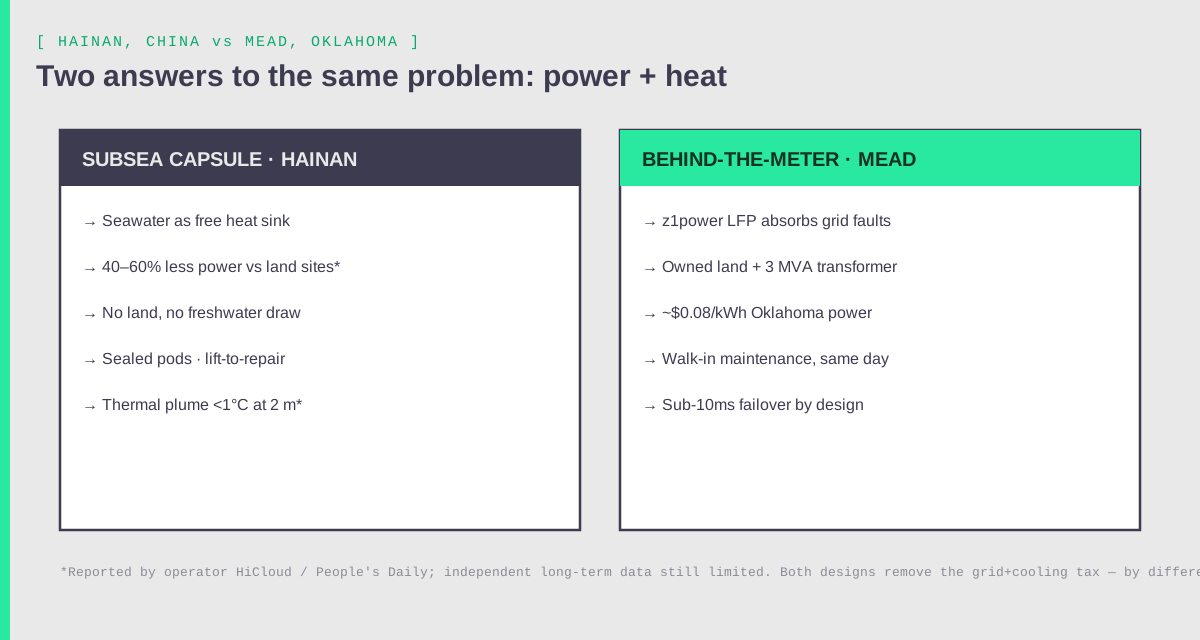
Because the two things that dominate a data center’s operating cost — cooling energy and water — are what the ocean provides for free. Seawater is an enormous, thermally stable heat sink; subsea designs pump it through rack-back radiators instead of running chillers. The Mercator Institute for China Studies (MERICS) reports the Hainan facility is 40–60 percent more power-efficient than comparable land sites, and state media reporting puts overall efficiency more than 30 percent ahead of conventional facilities of the same scale, with the thermal plume raising water temperature less than 1°C within two meters of the modules. Those are operator-side numbers and deserve independent verification — but even discounted, they explain the bet.
The trade nobody escapes
Subsea buys efficiency by giving up serviceability. A failed server in a sealed pressure vessel waits for a crane and a maintenance window; Microsoft’s Project Natick — the research ancestor of these deployments — famously ran sealed nitrogen atmospheres and simply accepted that dead hardware stayed dead until retrieval. Corrosion, biofouling, and marine-heat-wave scenarios (a 2022 study flagged warmer, oxygen-poor outlet water during heat waves) are live engineering questions. Land sites pay more for cooling and get same-day, walk-in repair in exchange.
What we actually took from it
- →Attack the biggest operating line with siting, not gadgets. Hainan uses free seawater; Mead uses ~$0.08/kWh Oklahoma power, an owned 3 MVA transformer, and z1power LFP batteries behind the meter. Both are siting decisions that make every later choice cheaper.
- →Pair the site with its natural energy source. Shanghai’s subsea pods plug into offshore wind; our 30 acres hold room for ~500 kW of solar feeding the same batteries.
- →Design for the failure you can actually fix. We keep two spare B200 GPUs outside all tenant contracts and chose serviceable racks over sealed exotics — because our comparative advantage is that a technician can be at the rack in minutes.
Subsea pods and behind-the-meter batteries are the same idea wearing different equipment: stop renting your power and cooling from the most expensive provider available, and let the site itself do the work.
Real and commercial. The Hainan facility off Lingshui, China has operated at 35 meters depth since late 2023 and is described by operators and Chinese state media as the world’s first commercial underwater data center. A second subsea site, partly wind-powered, went live off Shanghai in May 2026 with roughly 2,000 servers and a 24 MW design capacity.
Operator-reported figures range from 30 percent overall efficiency gains (People’s Daily, for Hainan) to 40–60 percent better power efficiency versus comparable land facilities (MERICS analysis). The savings come from using seawater as a free heat sink instead of running chillers. Independent long-term verification is still limited.
Serviceability, corrosion, and ecosystem questions. Hardware in a sealed subsea capsule cannot be repaired until the module is lifted; seawater is corrosive; and researchers have flagged that during marine heat waves the warmer, oxygen-poor discharge water could stress local marine life. Land-based designs trade higher cooling costs for same-day repair access.
No — we take the principle, not the plumbing. Our Mead, Oklahoma site gets its cost advantage from owned land, a 3 MVA transformer, cheap Oklahoma power, and z1power LFP batteries behind the meter, while keeping every server a walk-up repair.
- China is commercializing energy-efficient underwater data centers — MERICS
- Subsea server cooling: pioneering green data centers in South China — People’s Daily (Mar 2026)
- China’s wind-powered underwater data center off Shanghai — BGR (Jun 2026)
- China Powers AI Boom with Undersea Data Centers — Scientific American