The research is in: AI data centers need batteries at every layer
A 2026 wave of peer-reviewed work — from a Nature Energy paper to arXiv reviews — converges on one finding: AI power profiles break traditional data center design, and layered energy storage is the fix.
For twenty years, a data center looked like a steady load to the grid: big, boring, predictable. AI clusters ended that. Synchronized GPU training steps swing power draw by double-digit percentages in under a second, checkpoints create rhythmic surges, and a single cluster can ramp faster than the generators feeding it were designed to follow. In 2026 the academic community caught up to what operators were seeing on their meters — and the conclusion is remarkably consistent.
“AI DC load profiles differ fundamentally from traditional loads in their sub-second variability, making conventional ESS dispatch strategies insufficient.”
— Grid Integration of AI Data Centers, arXiv 2603.00415 (2026)
What the 2026 literature actually says
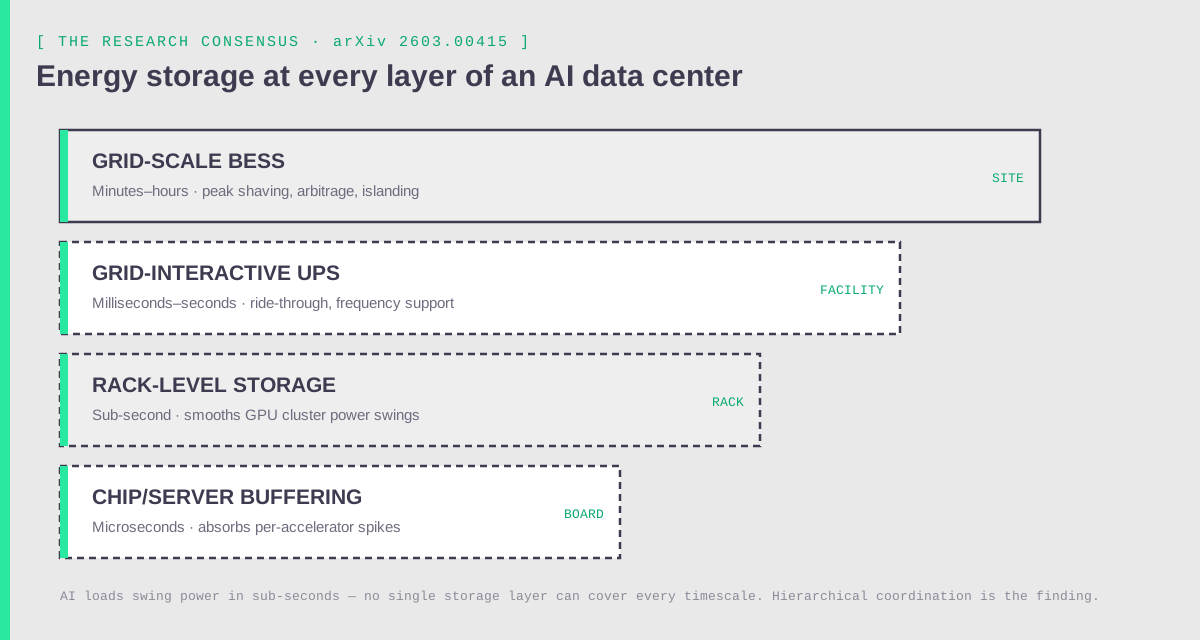
A critical review posted to arXiv this spring (2603.00415) surveys energy storage for AI data centers across every layer of the stack: grid-scale batteries for peak shaving and arbitrage, grid-interactive UPS for millisecond ride-through and frequency support, rack-level storage to smooth cluster power swings, and even chip-level buffering for per-accelerator spikes. Its three headline findings: AI loads are different in kind, not degree; no single storage layer covers every timescale, so hierarchical coordination is required; and the field still lacks good tools for degradation modeling and multi-layer sizing.
It is not one paper. Nature Energy published a perspective this year titled AI data centres as grid-interactive assets (vol. 11, 2026), arguing that batteries let compute campuses support the grid instead of stressing it. Another arXiv paper (2605.14105) shows batteries materially increase how much AI workload a hyperscale site can credibly commit day-ahead under Australia’s connect-and-manage interconnection rules. A third (2605.16190, from researchers including Argonne’s Sungho Shin) co-optimizes battery dispatch with workload scheduling and finds the benefits grow exactly when interconnection limits bind. A fourth (2603.20564) uses distributed batteries to smooth the voltage disturbances data centers inflict on their neighbors.
Where SmartTec sits in this picture
We did not design our Mead, Oklahoma site from these papers — we designed it from the same physics the papers describe. z1power LFP battery systems sit behind the meter as the site-level storage layer; the UPS layer rides through grid faults with sub-10-millisecond failover as the design target; and AURA, our orchestration software, is the coordination layer the literature keeps saying is missing — it sees the batteries, the grid, and the workload in one control loop.
Storage only pays if the alternative is expensive. Oklahoma commercial power at roughly $0.08/kWh plus an owned 3 MVA transformer means our batteries do resilience and peak management — not rate arbitrage against a $0.25/kWh colo bill. The economics of every paper above get easier when the site starts cheap.
The honest gaps
The same review is blunt about what is unsolved: battery degradation under high-cycle AI smoothing duty is poorly modeled, forecasting AI load remains hard, and multi-layer sizing is an open research problem. Anyone selling you a solved system is ahead of the science. Our approach is to instrument everything from day one and size conservatively — the 2 spare GPUs and the battery headroom in our Phase 1 design exist precisely because the models are young.
AI training clusters swing power draw in under a second as GPUs synchronize, which traditional grids and diesel generators cannot follow. Batteries respond in milliseconds, smoothing those swings, riding through grid faults, and letting sites commit more workload under constrained interconnection. Peer-reviewed work in 2026, including a Nature Energy perspective, treats battery-equipped data centers as grid assets rather than grid problems.
A grid-interactive UPS is an uninterruptible power supply that does more than backup: it responds to grid signals in milliseconds to provide frequency regulation and voltage ride-through while still protecting the IT load. The 2026 arXiv review 2603.00415 identifies it as the facility-level layer of a multi-layer storage architecture for AI data centers.
Lithium iron phosphate (LFP) dominates new data center storage because of its thermal stability, long cycle life (4,000+ cycles), and falling cost. SmartTec engineers z1power LFP modules with commercial-grade inverters and UPS into behind-the-meter storage at its Mead, Oklahoma site.
The physics scale down. A 110 kW GPU cluster sees the same sub-second power swings per rack as a hyperscale hall — the batteries just get smaller. Smaller sites arguably benefit more, because a single grid fault takes out 100% of their capacity, and behind-the-meter storage removes that single point of failure.
- Grid Integration of AI Data Centers: A Critical Review of Energy Storage Solutions — arXiv 2603.00415 (2026)
- AI data centres as grid-interactive assets — Nature Energy 11, 254–261 (2026)
- Battery-Assisted Operation of Hyperscale AI Data Centers — arXiv 2605.14105 (2026)
- Watts vs. Bytes: Storage-Compute Co-Optimization — arXiv 2605.16190 (2026)
- Online Feedback Optimization of Energy Storage to Smooth Data Center Grid Impacts — arXiv 2603.20564 (2026)