The thermal wall: what peer-reviewed cooling research says about your next GPU cluster
Air cooling is hitting a physical ceiling just as the average rack jumped 69% in a year to 27 kW and single GPUs crossed 1,000 watts. Here’s what the 2025–26 research literature says each cooling method can actually hold.
European cooling manufacturer HiRef calls it the thermal wall: the point where air physically cannot carry heat away fast enough, no matter how hard the fans spin. The industry is hitting it now. Average rack density reached roughly 27 kW in 2026 — a 69% jump in a single year — and an NVIDIA B200 dissipates about 1.2 kW by itself. Industry trackers put liquid cooling’s share of data centers at ~3% in 2021 and project roughly 37% in 2026. That is not a trend; that is a phase change.
What the peer-reviewed literature covers
The academic record has matured fast. A computational study of single-phase immersion for high-density server racks appeared in Applied Thermal Engineering (vol. 264, 2025); Energy & Built Environment (vol. 7, 2026) published a systematic review of single-phase immersion research; the International Journal of Heat and Fluid Flow (2026) reviewed all four two-phase chip-cooling approaches — immersion, spray, cold plate, and heat pipe; and a 2026 paper in Energy even co-designs cooling with nuclear-powered hyperscale campuses. Meanwhile the practical guidance in the EU Code of Conduct on Data Centre Energy Efficiency and the US DOE’s best-practices guide covers the unglamorous levers: inlet temperatures, humidity windows, and containment discipline.
The numbers that matter for operators
Benchmark data published by Supermicro and analyzed in 2026 industry TCO work shows liquid-cooled H100 nodes drawing roughly 1 kW less per node — about 16% — while sustaining around 17% higher throughput under stress, because GPUs stop thermal-throttling. One documented case saw junction temperatures fall from 83°C to 44°C on the same hardware after a cooling-loop change, cutting a 31-hour training job back to 22 hours. Cooling is not overhead; it is performance.
How we cool 30 B200s in an Oklahoma summer
Phase 1 at Mead runs about 114 kW of IT across eight HGX B200 servers — dense, but below the wall for well-executed air with hot/cold-aisle containment, which is exactly what our $150K Building 1 retrofit implements: 45 tons of installed cooling across three CRAC units. The honest engineering statement is that this is the last generation we expect to air-cool. The building design reserves the mechanical space and power for direct-to-chip liquid in Phase 2, because every roadmap — NVIDIA’s, the researchers’, and the market’s — points the same direction.
The EU Code of Conduct and the US DOE best-practices guide are free, vendor-neutral, and cover the containment and setpoint discipline that decides whether any cooling technology hits its rated numbers. Most cooling failures we hear about are airflow management failures wearing a technology costume.
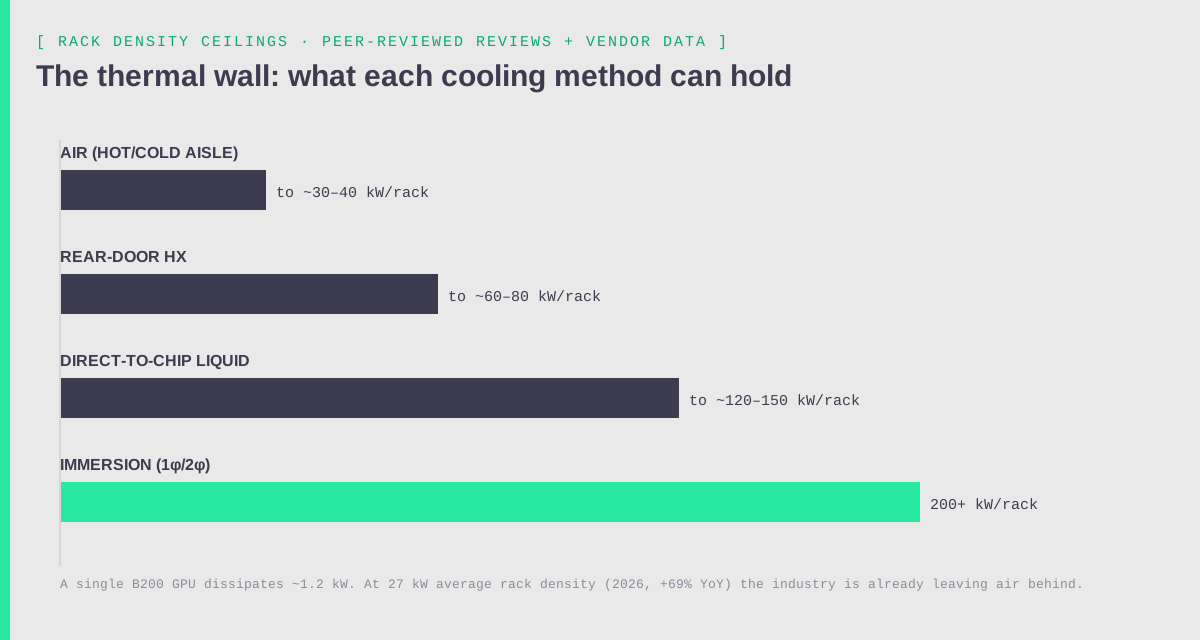
Well-executed air cooling with hot/cold-aisle containment generally holds to roughly 30–40 kW per rack; rear-door heat exchangers extend that to about 60–80 kW; direct-to-chip liquid handles 120 kW-class racks; and immersion systems are demonstrated at 200 kW and beyond. With the 2026 average rack at ~27 kW and climbing 69% year-over-year, most new AI builds are specifying liquid from day one.
Yes, measurably. Vendor benchmark data analyzed in 2026 shows liquid-cooled H100 nodes drawing about 16% less power while sustaining roughly 17% higher throughput, because lower junction temperatures prevent thermal throttling. In one documented case, a cooling-loop change alone cut a 31-hour training job to 22 hours on identical hardware.
Industry-reported 2026 ranges: traditional air cooling around 1.45–1.60, direct-to-chip liquid roughly 1.15–1.25, and immersion cooling 1.03–1.08. Every point of PUE is overhead energy billed at your power rate for all 8,760 hours of the year.
Phase 1A (8× HGX B200, 64 GPUs installed, ~114 kW IT) uses engineered air cooling — 45 tons installed across three CRAC units with hot/cold-aisle containment — with mechanical space and power reserved to move to direct-to-chip liquid in Phase 2 as densities rise.
- Computational study of single-phase immersion cooling — Applied Thermal Engineering 264 (2025), 125476
- Review of immersion liquid cooling for high-performance data centers — Energy & Built Environment 7 (2026)
- Two-phase liquid cooling on the chip side: summary and prospects — Int. J. Heat & Fluid Flow (2026)
- Liquid Cooling — The Imperative of 2026 — HiRef white paper
- Data center cooling economics 2026 — TCO analysis incl. Supermicro benchmarks